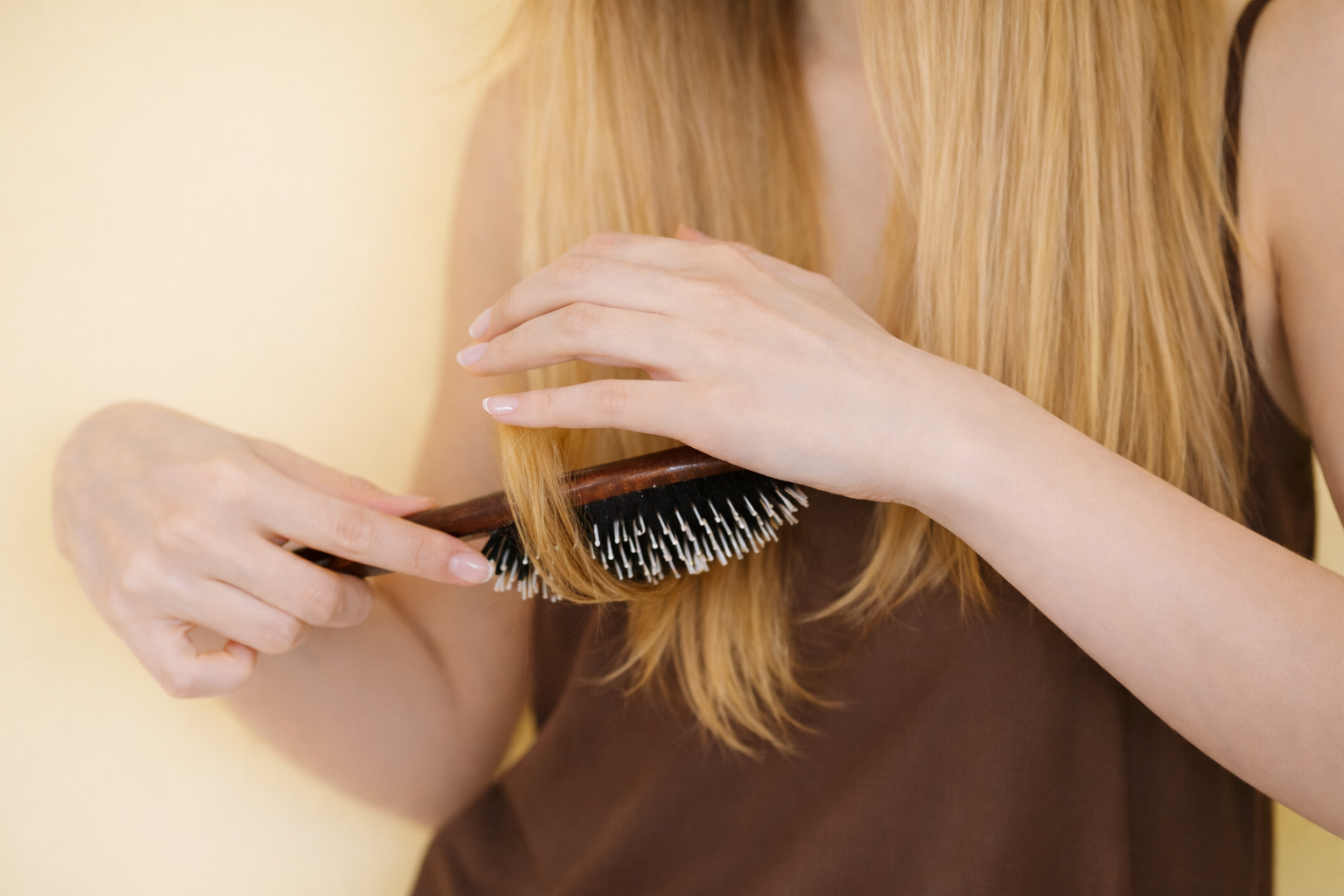
If you have long hair, you’ve likely encountered knots and tangled strands. In most cases, a comb and conditioner are enough to gently detangle your hair. However, if brushing becomes difficult or you cannot run your fingers through your strands, this may be a sign of hair mats. They often appear after removing hair extensions, due to the buildup of hair products, or after a long period without brushing.
There’s no need to panic: you can detangle hair mats at home without cutting your hair or visiting a professional. In our new guide, we’ve prepared step-by-step instructions detailing how to safely detangle your hair and prevent it from tangling again.
What are hair mats?
Hair mats form when strands—both still attached to the scalp and already shed—intertwine and twist, creating dense knots. These formations require special care and the use of specific detangling products. You can think of them as interwoven fibers merging into one or several compact clusters of disordered hair. Hair mats most commonly appear in people with dry or textured hair, such as curly or coiled types, but they can develop in any hair type.
Causes of Hair Tangles
Hair tangles can occur for various reasons. Below are the most common ones:
• Product buildup. The main cause of hair tangling is the accumulation of hair care products. This can happen due to styling products, shampoo that wasn’t fully rinsed out, or conditioners and masks left on the hair longer than recommended. Over time, this residue makes hair dull, coats strands with a thin film, and causes them to tangle easily with any friction.
• Lack of brushing. Hair can easily tangle and form knots if it isn’t brushed or combed regularly. In this case, the hair fibers lose moisture and tend to intertwine, which inevitably leads to tangles over time.
• Other possible causes include improper use of hair accessories or elastics, long periods without a haircut, lack of nighttime hair protection, as well as neglecting post-coloring or post-bleaching care instructions.
Who is most likely to experience tangled hair?
All hair types can develop tangles, but people with dry or textured hair tend to face this problem more often.
How to detangle knotted or matted hair
There are ways to detangle severely knotted or matted hair, and cutting is not always necessary—it should only be a last resort. Patience is key: work calmly and carefully, using the right products and tools to gently detangle the hair without causing damage.
Tools and Necessary Products
• Wide-tooth comb
• Wide-tooth comb
• Detangling brush
• Tail comb or curling comb
• Detangling primer
• Detangling spray
• Hair oil
• Moisturizing conditioner or treatment
Keep in mind that a small amount of hair shedding while combing is completely normal. Knots and tangles often form from hairs that have already shed.
Step-by-Step Guide
Once you have prepared all the necessary tools and products, you can proceed to detangle your hair. Follow this step-by-step guide:
• Generously apply a detangling spray to the entire tangled section of hair. Gently distribute the product with your fingers, making sure to coat each knot evenly.
• Carefully start detangling the hair with your fingers.
• Apply hair oil for extra smoothness. Then, using a wide-tooth comb, gently work through the strands, softly separating them from each other.
• Isolate the loose strands and begin gently detangling the hair with a brush, working from the ends toward the roots, gradually moving through the tangled sections.
• Alternate between using a brush, a wide-tooth comb, and a tail comb, depending on which works best for detangling the knotted areas.
• Generously apply a detangling spray to the entire tangled section of hair. Gently distribute the product with your fingers, making sure to coat each knot evenly.
• Carefully start detangling the hair with your fingers.
• Apply hair oil for extra smoothness. Then, using a wide-tooth comb, gently work through the strands, softly separating them from each other.
• Isolate the loose strands and begin gently detangling the hair with a brush, working from the ends toward the roots, gradually moving through the tangled sections.
• Alternate between using a brush, a wide-tooth comb, and a tail comb, depending on which works best for detangling the knotted areas.
• When the strands start to separate from the main mass, carefully comb them with a wide-tooth comb, removing all detangled hair. Apply conditioner to the ends for extra moisture and protection. Repeat these steps until the knot is completely detangled.
If the steps above don’t work
In particularly difficult cases, first apply oil to the hair and distribute it thoroughly over the matted area with your fingers. Start at the middle of the knot, gently loosening it and widening it to identify individual free strands you can work with. In this situation, using the tip of a tail comb is especially helpful — it creates extra space, making it easier to untangle the knot. After this, proceed with the further steps described above.
When to cut the hair
If a comb (even the thin tip) cannot manage the tangle, cutting may be the only solution. Trimming should also be considered if attempts to detangle the hair cause excessive pulling and discomfort.
If you haven’t combed your hair for several weeks or even months, cutting the knot is often the most practical option. Fully untangling it can take several hours, and the duration depends on your patience and the density of the tangle.
How to Prevent Hair from Tangling
After successfully detangling your hair, it’s natural to want to prevent tangles in the future. Proper scalp and hair care play a key role here. Below are some habits that can help keep your hair smooth and healthy:
• Use special accessories that prevent tangling and snagging.
• Visit your hairdresser regularly.
• Keep your hair ends moisturized by regularly applying a serum or leave-in treatment for protection and nourishment.
• If your hair is long or prone to tangling, protect it at night with a silk pillowcase, soft scarf, or lightweight cap.
• Avoid excessive use of hairspray and harsh teasing, as they can lead to tangling and knots.
• Gently comb your hair after every wash to prevent tangles and maintain its health.
• Use special accessories that prevent tangling and snagging.
• Visit your hairdresser regularly.
• Keep your hair ends moisturized by regularly applying a serum or leave-in treatment for protection and nourishment.
• If your hair is long or prone to tangling, protect it at night with a silk pillowcase, soft scarf, or lightweight cap.
• Avoid excessive use of hairspray and harsh teasing, as they can lead to tangling and knots.
• Gently comb your hair after every wash to prevent tangles and maintain its health.
⸻
Tangled hair can be quite troublesome, even when you have all the necessary products and tools. Remember: knots are a natural occurrence. The key is to be patient and regularly moisturize your hair to restore its softness and smoothness. And if you need to trim the ends, don’t worry — your hair will grow back.
Read also: How to Repair Hair Damaged by Bleaching: 12 Expert-Approved Tips
Read also: How to Repair Hair Damaged by Bleaching: 12 Expert-Approved Tips